









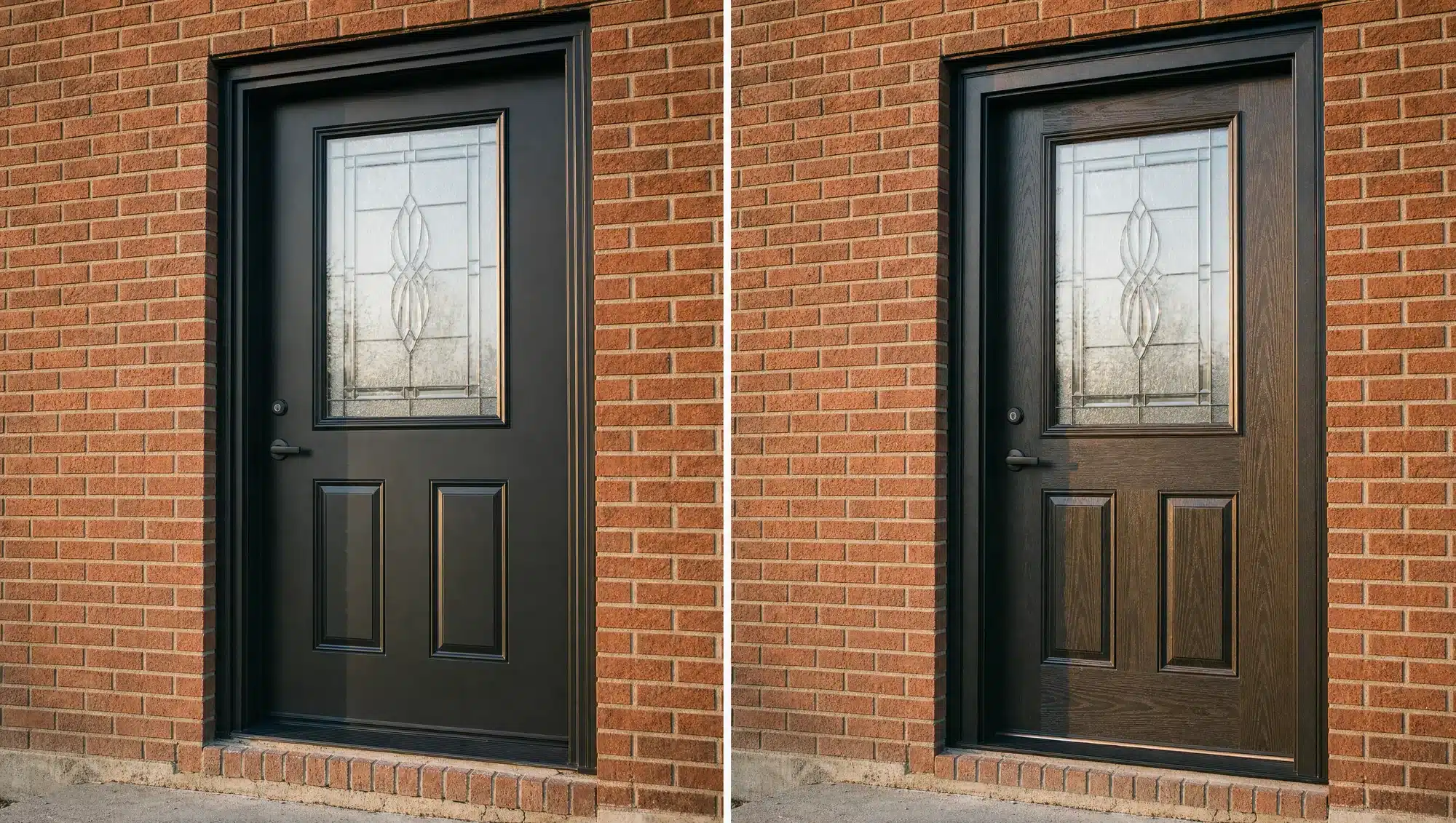
It is the question we field most often in the showroom, and it rarely gets a straight answer online. Steel and fibreglass are the two materials that dominate the Canadian entry door market, both are dramatically more efficient than the solid wood door they usually replace, and both will outlast the door currently on your house. So the honest answer is not that one is better. It is that they fail differently, they age differently, and they cost differently — and which of those matters most depends on your doorway.
Advanced Home Services has been installing entry doors across Windsor-Essex since 1989. In 37 years we have pulled out plenty of both materials, and the patterns are consistent enough to be useful. Below is the comparison as we would give it to you across the counter, with the performance claims tied to the standards that actually govern them rather than to marketing copy.
The Short Answer
Choose fibreglass if your door gets heavy direct sun, faces the weather without a covered porch, needs to look like wood, or sits in an opening you would rather not revisit for decades. Fibreglass will not dent, will not rust, and holds a finish longer in exposed conditions.
Choose steel if budget is the deciding factor, the door is sheltered by a porch or overhang, or the opening is a secondary entrance — a side door, a garage-entry door, a rear door. Steel delivers comparable insulating performance for less money and, per national resale data, is one of the highest-return exterior projects a homeowner can do.
Both materials can be ENERGY STAR certified in Canada. Neither material, on its own, makes a door secure — the lock, frame and installation do that. More on both points below.
Steel vs Fibreglass at a Glance
| Factor | Steel | Fibreglass |
|---|---|---|
| Insulating value | R-5 to R-6 (foam core, no glass) | R-5 to R-6 (foam core, no glass) |
| Dent resistance | Dents from impact; dents are permanent | Will not dent; can crack under severe impact |
| Rust and corrosion | Can rust where the finish is breached | Cannot rust |
| Heavy direct sun | More prone to heat build-up and finish fade, especially in dark colours | Handles solar exposure better; holds dark colours longer |
| Appearance | Smooth, painted; crisp and contemporary | Smooth or deep woodgrain embossing; can be stained to read as wood |
| Maintenance | Repaint periodically; touch up scratches promptly to prevent rust | Occasional refinishing; no rust risk from a scratch |
| Relative cost | Lower | Higher |
| Best suited to | Sheltered entries, side and rear doors, budget-led replacements | Exposed front entries, sun-facing doors, wood-look requirements |
Insulating values reflect the range the U.S. Department of Energy reports for insulated steel and fibreglass-clad entry doors, excluding glass. Adding glazing lowers the assembly’s overall performance.
How the Two Are Actually Built
Both materials are skins over a foam core. That is the single most important thing to understand, because it explains why their insulating numbers are so similar and why the differences show up everywhere else.
Steel entry doors
A steel entry door is a formed steel skin bonded to a rigid foam core, most commonly polyurethane. The U.S. Department of Energy describes this construction directly, noting that a common exterior door type has a steel skin with a polyurethane foam insulation core and a magnetic weatherstrip, and that such a door needs no further weatherstripping provided it is installed correctly and not bent. That last clause is doing a lot of work. A magnetic seal depends on the slab staying flat and the frame staying square, which is why installation quality matters more on steel than most homeowners expect.
Fibreglass entry doors
A fibreglass door — or fiberglass, if you are reading American product literature — uses a moulded fibreglass composite skin over the same kind of foam core. The skin can be moulded smooth or with a deep woodgrain texture that accepts stain, which is why fibreglass is the default when a homeowner wants the look of a wood door without the upkeep. Because the skin is a composite rather than a metal, it has no corrosion pathway at all.
You can see both materials finished and hung at our showroom, and our project gallery shows how each reads on real Windsor-Essex homes, which is usually more persuasive than a sample chip.
Energy Performance: What the Ratings Actually Mean
Here is where most comparison articles go wrong. They quote R-values as though the slab material determines efficiency. It largely does not — the foam core and the perimeter seal do, and the numbers that count in Canada are not R-values at all.
To carry the ENERGY STAR mark in Canada, a door must meet Natural Resources Canada’s fenestration technical specification. A door qualifies by one of two routes: a maximum U-factor of 1.22 W/m²·K (0.21 Btu/h·ft²·°F), or a minimum Energy Rating (ER) of 34. Energy Rating is the more useful of the two for a homeowner because it is a balanced figure — it accounts for U-factor, solar heat gain and air leakage together rather than heat loss alone.
Separately, the specification caps air leakage: both infiltration and exfiltration must be no greater than 1.5 L/s/m². Performance must be certified under CSA A440.2-14 or CSA A440.2-19, or under the ANSI/NFRC 100 and 200 series, by a body accredited by the Standards Council of Canada or by the NFRC. Doors must also meet the North American Fenestration Standard with Canadian supplements, and the model has to be registered with NRCan before it can legally be labelled ENERGY STAR certified in Canada.
Two practical takeaways. First, material is not the variable — a well-built steel door and a well-built fibreglass door can both clear the same threshold. Ask for the U-factor or ER on the specific model, not a claim about the category. Second, air leakage is a tested, regulated property, and it is the one most affected by how well the door was installed. A certified door fitted into a racked opening does not perform to its label.
If rebate eligibility is part of your decision, note that Canadian incentive programs generally key off ENERGY STAR certification, and both program terms and deadlines change. Confirm current eligibility before you order rather than assuming last year’s rules still apply.
Durability in a Windsor-Essex Climate
Windsor-Essex gives an entry door a specific workout: humid summers, freeze-thaw cycling through the shoulder seasons, and lake-influenced wind and driving rain. Here is where the two materials genuinely diverge.
Dents and impact
Steel dents, and a dent in a steel skin is permanent. It cannot be sanded out. On a busy family entrance, a door that takes hockey bags, strollers and the occasional misjudged snow shovel, this is the failure we see most. Fibreglass does not dent — under severe impact it can crack instead, which is rarer but harder to disguise.
Rust and corrosion
This is the one that decides a lot of Windsor doorways. A scratch through a steel door’s finish opens a corrosion pathway, and road salt tracked onto a threshold through an Essex County winter accelerates it. Caught early and touched up, it is a non-issue. Left for a few seasons on an exposed door, rust bleeds and spreads under the coating. Fibreglass has no equivalent failure because there is no metal to oxidise.
Direct sun and dark colours
Deep charcoal and black front doors have been the dominant colour choice for years, and they absorb substantially more solar energy than a light finish. On a south or west-facing entrance with no porch, that heat load is real. Fibreglass generally tolerates it better and holds a dark finish longer.
There is a related trap worth naming. The Department of Energy specifically warns that a glass storm door can trap heat against an entry door and cause damage where the exterior door gets more than a few hours of direct sun each day, and notes that low-e glass reduces the heat gained. If you have a sun-facing entrance and you are considering adding a storm door over a new dark-coloured slab, raise it with us before you order — it is a combination that can void a slab warranty.
Freeze-thaw and moisture
Neither foam-core material absorbs water the way solid wood does, so neither swells and binds seasonally the way an old wood door will. What does move is the frame and the opening around it, particularly in this region’s clay soils. When a door starts sticking or the deadbolt stops meeting the strike cleanly, the slab is usually innocent — the opening has shifted.
Security: Why the Slab Matters Less Than You Think
Homeowners reliably assume steel is the secure choice because it is metal. In practice, forced entry almost never involves defeating the slab. It involves defeating the lock, the strike plate, or the jamb the strike is screwed into.
The standards reflect that. Residential door hardware is graded under the ANSI/BHMA A156 series, which the Builders Hardware Manufacturers Association maintains across 42 separate standards. Most use three grades, with Grade 1 the highest performance, then Grade 2 and Grade 3. Products are evaluated across six test categories — operational, cycle, strength, security, material evaluation and finish. Residential deadbolts have their own standard, ANSI/BHMA A156.40, and some jurisdictions require an exterior deadbolt with a 1 inch (25.4 mm) projection specifically to improve security. BHMA is candid that these are laboratory tests with no absolute correlation to field performance — but a Grade 1 deadbolt into a reinforced strike is a far bigger upgrade than changing slab material.
Door assemblies are also tested for forced entry resistance under the North American Fenestration Standard, AAMA/WDMA/CSA 101/I.S.2/A440. FGIA notes that NAFS covers structural integrity, resistance to water penetration, air leakage and forced entry, and that the 2005 edition was the first to include requirements for side-hinged exterior doors. The 2022 edition is the current version.
Our recommendation on either material is the same: a Grade 1 deadbolt, a reinforced strike with long screws into the framing rather than the jamb alone, and where the configuration allows it, multi-point hardware that engages at more than one point in the frame.
Maintenance and Lifespan
Both materials will comfortably outlast the door they replace. The maintenance profile is what differs.
Steel wants vigilance about coating integrity. Touch up chips and scratches when they happen, and a steel door will serve for decades; ignore them on a weather-exposed entrance and rust will shorten its life considerably. Repainting is straightforward.
Fibreglass wants less attention and forgives neglect better, because a scratch is cosmetic rather than the start of a corrosion problem. Stained fibreglass will eventually need refinishing, on a cycle driven by exposure — a sheltered north-facing door might go many years, while a fully exposed west elevation will want attention sooner.
In both cases the component that actually determines whether your door still performs is the weatherstripping, not the slab. Seals compress and harden with age. Replacing worn weatherstripping is inexpensive and restores most of the air-tightness a tired door has lost — worth doing before you conclude the door itself is finished.
Cost and Return on Investment
Steel costs less than fibreglass for a comparable configuration. That gap widens as you add glass, sidelites and decorative options, because those upgrades are priced on top of a higher base.
What makes the cost conversation interesting is resale performance. In the 2025 Cost vs. Value Report published by the Journal of Light Construction, replacing an entry door with an insulated steel unit ranked second among all surveyed projects for return on investment. The prior year’s report put the figure at 188% of cost recouped — the project returning more at resale than it cost to complete. The report compares average costs against resale value across 28 remodelling projects in 119 markets.
Two caveats, stated plainly. That data is American, so treat it as directional for a Windsor homeowner rather than a promise about Essex County resale. And the category is specifically a modest insulated steel replacement — it is a story about high-impact, low-cost curb appeal, not evidence that every door upgrade pays for itself. An upscale fibreglass entrance with sidelites and a transom is a different project with a different return profile.
For a breakdown of what drives an installed price, see our guide to door installation cost in Ontario.
The Verdict by Scenario
Rather than a single winner, here is how the decision resolves in the situations we actually encounter across Windsor, LaSalle, Tecumseh, Amherstburg, Essex, Lakeshore, Kingsville and Leamington.
A south or west-facing front door with no porch — choose fibreglass
Full sun exposure plus a dark colour is the hardest condition an entry door faces in this region. Fibreglass holds its finish longer and handles the heat load better. This is the clearest verdict on the list.
A sheltered front entrance under a deep porch — steel is excellent value
Take away direct sun and driving rain and steel’s disadvantages largely disappear. On a covered entry you are paying a premium for fibreglass and getting comparatively little back.
A busy family entrance that takes real abuse — choose fibreglass
Bikes, hockey bags, strollers, deliveries. Dents are the failure mode here, and only one of these materials is immune to them.
A side, rear or garage-entry door — choose steel
Secondary doors are usually sheltered, rarely the focal point of the elevation, and a sensible place to control budget. Steel is the pragmatic answer.
You want the look of a stained wood door — choose fibreglass
Woodgrain-embossed fibreglass that takes stain is the only one of the two that reads convincingly as wood. Steel can be beautiful, but it reads as painted steel.
A heritage or character home in Walkerville or Olde Sandwich Towne — usually fibreglass
Where the elevation calls for a wood appearance and a period-appropriate panel profile, fibreglass gets you there without committing to maintaining a real wood door in this climate.
Budget is the binding constraint — choose steel, and put the savings into the lock
A steel door with Grade 1 hardware and a properly reinforced strike is a better outcome than a fibreglass door with builder-grade hardware. Spend where the security actually lives.
You are selling within a year or two — steel, kept modest
This is precisely the scenario the Cost vs. Value data speaks to. A clean insulated steel replacement in a current colour is the high-leverage move.
Frequently Asked Questions
Is steel or fiberglass better for a front door?
Neither is universally better. Fibreglass is the stronger choice for exposed, sun-facing or high-traffic entrances because it will not dent, rust or fade as readily. Steel is the better value on sheltered entries and secondary doors, and it carries the strongest documented resale return of any exterior door category. Because both materials use the same kind of insulating foam core, energy performance is driven by the specific model’s certified rating rather than by the material itself.
Which lasts longer, a steel or fiberglass entry door?
Both will outlast the door they replace by a wide margin, but fibreglass tends to age better with less intervention. Steel’s lifespan is closely tied to maintenance — a chip touched up promptly is nothing, while the same chip ignored on a weather-exposed door starts rust that spreads under the coating. Fibreglass has no corrosion pathway, so a scratch stays cosmetic.
Do steel doors rust in Ontario winters?
Only where the protective finish has been breached. Intact factory-finished steel does not rust. The risk comes from chips and deep scratches, and it is accelerated by road salt tracked onto the threshold. Inspect the bottom of a steel door and the area around the lockset each spring, and touch up any exposed metal. On heavily exposed entrances this is the main argument for choosing fibreglass instead.
Are fiberglass doors worth the extra cost?
On an exposed front entrance, a sun-facing elevation, or a high-traffic family door — generally yes, because you are buying out of the two failure modes that actually shorten a door’s life in this climate. On a sheltered porch or a secondary entrance, the premium is harder to justify, and the money is often better spent on better hardware or a properly capped and sealed installation.
Does the door material affect energy efficiency?
Far less than most people assume. The U.S. Department of Energy puts insulated steel and fibreglass-clad entry doors in the same R-5 to R-6 range excluding glass, because the foam core does the insulating in both. What matters is the certified rating on the specific model — in Canada, a maximum U-factor of 1.22 W/m²·K or a minimum Energy Rating of 34 to qualify for ENERGY STAR — along with the air-tightness of the installed assembly.
Is a steel door more secure than a fiberglass one?
Not meaningfully. Forced entry typically defeats the lock, strike plate or jamb rather than the slab. Both materials are tested for forced entry resistance as complete assemblies under the North American Fenestration Standard. The upgrades that change your security are a Grade 1 deadbolt under the ANSI/BHMA standards, a reinforced strike anchored into the framing with long screws, and multi-point hardware where the door allows it.
Can I add glass or sidelites to either material?
Yes, both are available with a wide range of glass, decorative and privacy options, sidelites and transoms. Bear in mind that glazing reduces the assembly’s insulating performance relative to a solid slab, so if efficiency is a priority, ask us for the rated numbers on the configuration you are considering rather than on the door alone.
See Both Materials Before You Decide
A sample chip and a spec sheet only get you so far. Both materials are hung and finished in our Windsor showroom, where you can open them, feel the weight, and see how a woodgrain fibreglass finish reads next to a smooth painted steel slab under real light. We will also tell you honestly when the cheaper material is the right answer for your opening — that has been the practice since 1989, and it is why we do not use subcontractors.
Explore our steel entry doors and fibreglass entry doors, read about our door installation process, or browse the full doors collection. Every installation is covered by our Platinum Warranty and carried out by SAWDAC-trained installers.
We serve homeowners throughout Windsor-Essex — see our service locations, including LaSalle, Tecumseh and Amherstburg.