










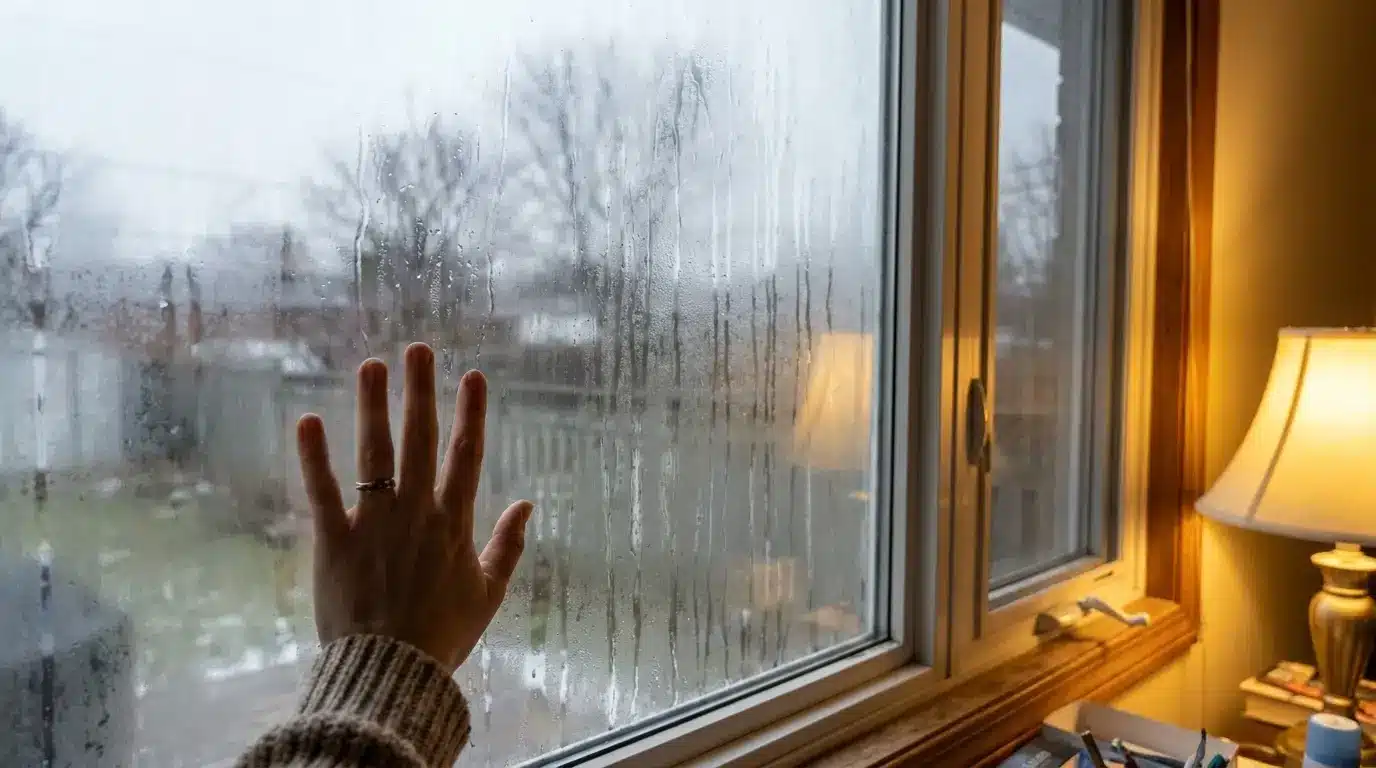
Window condensation between the panes is one of the most common calls we take at Advanced Home Services — and one of the most misunderstood problems homeowners encounter. If you’re looking at a foggy, hazy, or moisture-streaked pane of glass that you can’t wipe clean from either side, this article is for you.
The short answer: condensation between the panes means your window’s seal has failed. The moisture you’re seeing is trapped inside the insulated glass unit, which means the argon gas fill is gone, the window’s thermal performance has dropped, and the problem will not go away on its own.
Here’s what’s actually happening, what your options are, and how Windsor-Essex’s climate makes this more common than homeowners expect.
Not all window condensation is the same — location tells you everything
The moisture is trapped inside the insulated glass unit. You can see it but can’t wipe it from either side. The argon fill is gone and the window’s thermal performance has dropped.
Action required — assess for IGU replacement or full window replacement.
Warm humid indoor air contacting a cold glass surface. Most common in kitchens, bathrooms, and laundry rooms. Usually resolved with better ventilation. Not a seal failure.
Improve ventilation. Consider Low-E glass at next replacement.
Morning dew on the outside means the exterior pane is cooler than the outdoor dew point — which only happens when the window is insulating so well that almost no heat escapes from inside.
No action needed. This is exactly what you want to see.
Why Condensation Forms Between Window Panes
Modern double-pane and triple-pane windows are built around an insulated glass unit, or IGU. An IGU is a sealed assembly of two or three glass panes with a space between them — typically filled with argon gas — held apart by a spacer bar and sealed around the perimeter with a primary and secondary sealant.
That sealed cavity is what provides the thermal performance you’re paying for. The argon fill is denser than air and slows heat transfer across the glass. The sealed environment keeps moisture out of the cavity. When everything is working correctly, you have a window that performs at its rated U-factor and keeps your home comfortable in both summer and winter.
When the perimeter seal fails, that protected environment is breached. Outside air carrying humidity enters the cavity. When temperatures drop, that humidity condenses on the inner glass surfaces — where you can see it but can’t reach it. The condensation you’re looking at is the symptom. The failed seal is the problem.
What Causes Window Seals to Fail?
Seal failure isn’t a manufacturing defect in most cases. It’s a natural outcome of years of thermal stress.
Every day, your windows expand and contract with temperature changes. The glass, the spacer bar, the frame, and the sealant all have different thermal expansion coefficients — meaning they expand and contract at different rates. Over time, that differential movement fatigues the sealant at the edges of the IGU. Eventually it develops micro-cracks, the hermetic seal is compromised, and moisture begins cycling in and out of the cavity with each temperature change.
Windsor-Essex’s climate accelerates this process. We experience more freeze-thaw events than most of Ontario — days where the temperature crosses zero degrees multiple times — and that cycling is particularly hard on IGU seals. A window installed in Windsor may show seal failure earlier than the same product installed in a less cyclically stressed climate. It’s not a defect in the window; it’s the reality of our environment.
Other contributors to premature seal failure include:
Poor original installation.
If the window wasn’t shimmed and flashed correctly, or if the rough opening allowed the frame to rack over time, the differential stress on the IGU can cause early seal failure. This is one of the strongest arguments for using an experienced local installer rather than the lowest bidder.
Caulking failure.
When the exterior caulk around the window frame degrades and allows water to pool at the sill, moisture exposure accelerates seal deterioration. Keeping caulking maintained is the most cost-effective preventive maintenance for your windows.
Direct water infiltration.
Small cracks in the frame or sash can allow moisture to enter the gap between panes, even without complete seal failure. These cases typically start as a small cloudy patch in one corner and grow over time.
Why IGU seals fail — and why it happens sooner in Windsor-Essex
Every temperature change causes the glass, frame, spacer, and sealant to expand and contract at different rates. Over years this fatigues the sealant at the IGU edge until micro-cracks form.
Primary cause in this regionSealants harden and become brittle over time even without dramatic events. UV exposure accelerates degradation, particularly on south-facing windows.
Expected after 15 to 25 yearsA frame that wasn’t shimmed correctly puts uneven stress on the IGU edges. Early seal failures before year 10 are almost always installation-related.
Causes premature failureFailed exterior caulking allows water to pool at the sill. Persistent moisture exposure accelerates seal breakdown, particularly at the bottom corners where moisture collects first.
Preventable with maintenanceIs Window Condensation Between Panes a Sign You Need to Replace the Whole Window?
Not necessarily — but it depends on the condition of the frame.
An IGU can be replaced independently of the frame in many cases. If the frame is structurally sound — no warping, no rot, no water damage, hardware still functional — a glazier or window repair specialist can remove the failed glass unit and install a new IGU in the existing sash. This is generally less expensive than a full window replacement and makes sense when the window is less than 15 years old and the frame is in good condition.
However, if any of the following are true, full window replacement is the better call:
The frame is warped, cracked, or soft. Damaged frames cannot hold a new IGU properly and will cause the new unit to fail prematurely. The window is more than 20 years old. At that age, even if the current IGU replacement works, another seal failure is likely within a few years. Multiple IGUs in your home have already failed. This indicates a systemic issue — either installation-related or climate stress over an older generation of windows — and scattered repairs will keep costing you money. The current window doesn’t meet your home’s current energy efficiency needs. Older double-pane units without Low-E coatings or argon fill perform significantly below current Energy Star standards. If you’re already replacing the glass, it may be worth upgrading to a better-performing unit entirely.
Our window repair tool can assess whether your specific situation calls for an IGU replacement or a full window swap. We’ll give you a direct, honest recommendation — not an upsell.
IGU replacement vs full window replacement after seal failure
| Situation | IGU only | Full window |
|---|---|---|
| Frame is sound with no rot or damage | Good option | Optional |
| Window under 15 years old, well installed | Good option | Optional |
| Frame is warped, cracked, or soft | Won’t hold | Required |
| Window is more than 20 years old | Short-term only | Recommended |
| Multiple units failing across the home | Gets expensive | Better economics |
| Window lacks Low-E coating or adequate glazing | Possible upgrade | Full performance gain |
What About DIY Defogging Kits?
They exist. We don’t recommend them.
Defogging kits involve drilling small holes into the glass to allow moisture to escape, then applying a treatment to the interior surface. The fog may clear temporarily. The insulating properties will not be restored. The drilled holes permanently open the unit to outside air, which causes ongoing mineral etching on the interior glass surfaces and eliminates any remaining thermal performance the unit had.
Beyond the functional problems, a defogged-but-not-replaced IGU may raise questions during a home inspection. Documentation of professional window maintenance and replacement has become increasingly relevant during real estate transactions in Ontario.
The short version: DIY defogging is a cosmetic fix that permanently compromises the unit. It’s not worth it.
What Window Condensation on the Glass Surface Means (And Why It’s Different)
There’s an important distinction worth making clearly.
Condensation on the interior glass surface — on the room-facing side of the glass — is common in winter and is not a sign of seal failure. It means warm, humid indoor air is contacting a cold glass surface. You’ll see this most often in kitchens, bathrooms, and laundry rooms. Better ventilation, a dehumidifier, or improved air circulation typically resolves it. It can also indicate that your windows don’t have adequate Low-E coating for your climate zone — something to consider at replacement time — but it is not an IGU failure.
Condensation on the exterior glass surface — on the outside face of the glass in the morning — is actually a sign that your windows are working well. It means the exterior glass surface is cooler than the dew point of the outside air, which happens when the window is insulating so effectively that little heat is escaping from inside. This is normal and harmless.
Condensation between the panes, the subject of this article, is the only type that indicates seal failure and reduced thermal performance.
Checking Your Windows for Seal Failure Right Now
Here’s a quick self-check you can do without any tools:
Look at each pane of glass from an angle with light behind it. Failed seals often show as a hazy film, a white mineral deposit pattern, or visible moisture droplets in the cavity — particularly at the bottom corners of the unit, where moisture tends to pool first. In early-stage failures, you may see what looks like a watermark or a slight cloudiness that wasn’t there before. In advanced failures, the entire unit may appear frosted.
If you find it, note which windows are affected and roughly how severe. A single failed unit in a 20-year-old home may be a targeted repair. Multiple failed units across several windows usually means it’s time to look at a more comprehensive replacement plan.
Window condensation between the panes doesn’t mean your home is failing — it means your windows have reached a natural endpoint and it’s time to address it. The good news is that Windsor-Essex homeowners have reliable options, from targeted IGU replacement on newer windows to full window replacement on older or more extensively damaged units.
Book a free window assessment with Advanced Home Services and we’ll inspect every window in your home, identify which have failed seals, and recommend exactly what each one needs. No guesswork, no pressure — just a straight answer from a team that’s been doing this in Windsor-Essex since 1988.